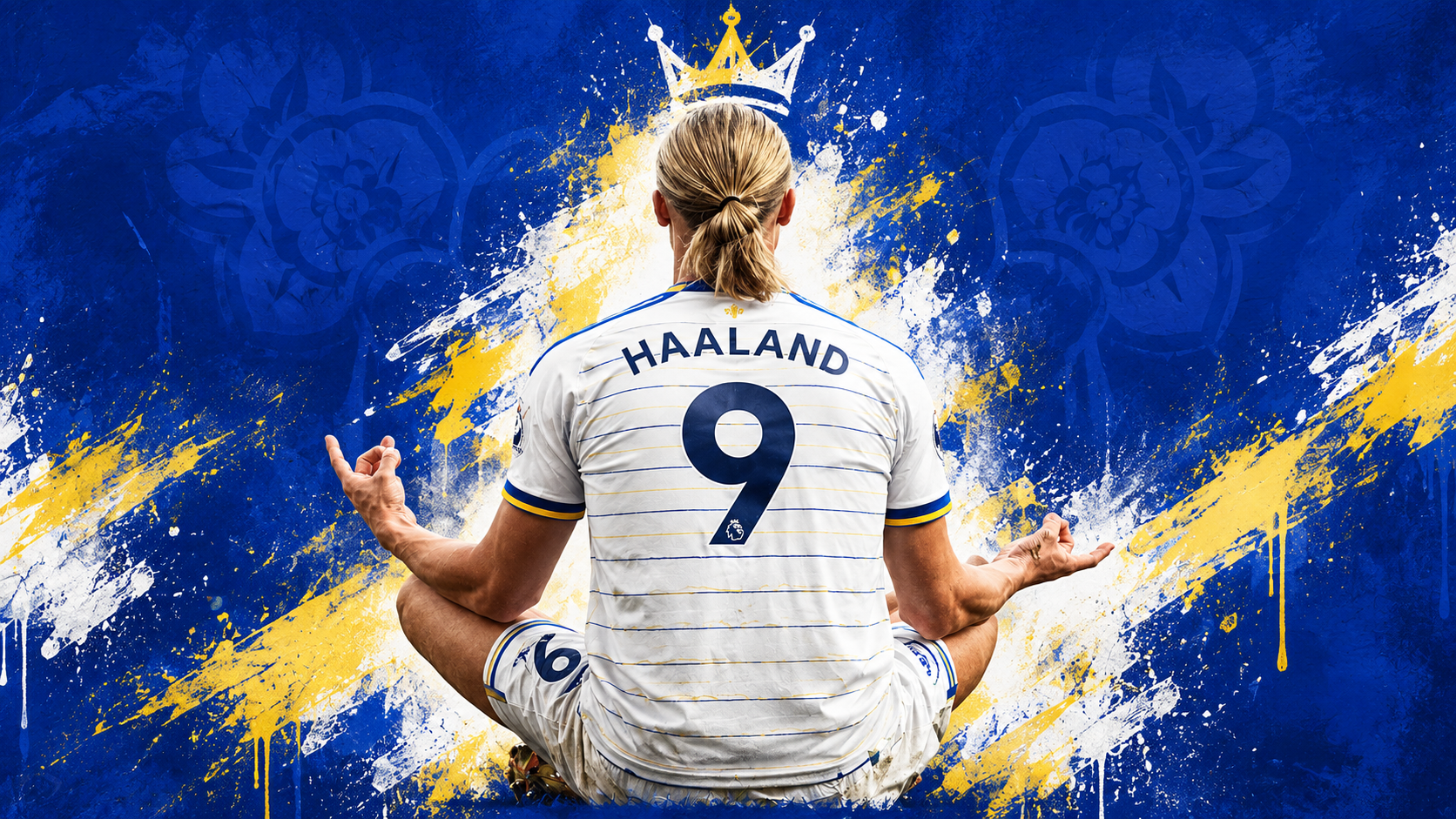
If you’re reading this, then you’ll already know the tale: Erling Haaland, son of Alf-Inge, born in Leeds in July 2000 while his father was still contracted to the club.
Leeds born. Leeds supporting. Leeds in the blood. Leeds in the family. And yet, somehow, never a Leeds United player.
If you could build a footballer from the ground up, you’d probably end up with something resembling Haaland. Pace, power, strength, hunger, desire and an ability to finish chances that sends shivers down the spines of defenders worldwide. At 6’5” he’s enormous, ridiculously quick for his size and, more often than not, if you give him a sight of goal, the ball ends up in the back of the net. On top of that, his statistics are absolutely frightening:
114 goals in 134 Premier League games.
57 goals in 58 Champions League games.
These aren’t numbers from a player going out to Saudi Arabia to stat pad and claim he’s the highest goalscorer of all time. This is a striker, operating at the highest level, who hasn’t even hit his “peak” years yet. Haaland is now one of the most recognisable footballers on the planet. A serial goalscorer, a Champions League winner and a player who, in today’s completely batshit transfer market, would comfortably command a fee well in excess of £100 million.
But there’s another part of the Erling Haaland story that Leeds supporters know all too well. Because before Manchester City, before Borussia Dortmund, before Red Bull Salzburg and before he became the goalscoring freak we know today, there was an opportunity for Leeds United to sign him.
Not for £100 million.
Not even close.
And that’s where this story becomes painful.

What if…Leeds United had signed Erling Haaland when he was a teenager at Molde?
Haaland made his senior debut for Norwegian side Bryne after Alf Ingve Berntsen, the coach he had worked closely with at youth level, was promoted to caretaker manager. Berntsen handed him his first start at just 15 years old and, after initially deploying him out wide, eventually moved him into his preferred central role. Haaland failed to score during his breakthrough season, was offered a trial by Hoffenheim and eventually moved to Molde to play under Ole Gunnar Solskjaer.
At this point, however, Haaland was not the physical oddity we have become used to. His path through Norway’s youth setup crossed with Gunnar Halle, who later explained that Haaland’s “gangly physique” meant there were genuine questions over just how far he could go. Speaking to Goal, Halle admitted that nobody could have imagined what Haaland would eventually become, suggesting that his lack of physical dominance actually forced him to learn how to read the game. That context is important to understand because it’s incredibly easy, sitting here in 2026, to look at Erling Haaland and wonder how clubs and scouts failed to recognise what was standing in front of them.
But Leeds did recognise something.
And that’s where our story really begins. Back in 2021, agent Hayden Evans revealed on The Athletic’s The Phil Hay Show that during the 2017/18 season, while Haaland was still at Molde, he and his dad Alf-Inge were brought over to Leeds. They stayed at Oulton Hall. They met Victor Orta. Haaland was even presented with a Leeds shirt bearing his name. More importantly, he wanted to be there. Haaland had asked to see Thorp Arch, and Thomas Christiansen stopped a first-team training session to come over and speak to him, and by all accounts, the visit went well. Leeds United had Erling Haaland in the building.
And then they let him leave.
Molde wanted around £4 million, but Leeds weren’t financially comfortable enough to spend that on a teenager who wasn’t expected to go straight into the first team. And after putting together a Victor Orta superteam, who could blame them? In reality, Leeds walked away. Haaland went to Salzburg, and the rest is football history.
But we’re not dealing in reality anymore. We’re going back to 2017. Back to Oulton Hall. Back to Thorp Arch. Back to the moment when one of the greatest strikers of his generation was standing within touching distance of becoming a Leeds United player.
This time, Andrea Radrizzani finds the money.
This time, Leeds pay the £4 million.
This time, Erling Haaland signs for Leeds United.
Does Leeds United in 2017 actually develop Erling Haaland into Erling Haaland?

Leeds United in 2017/18 wasn’t the stable and, dare I say it, ‘normal’ club that you see today. In typical Leeds fashion, we started the season chaotically. Garry ‘The Snake’ Monk left to manage newly relegated Middlesbrough, a decision his managerial career has never really recovered from. On top of that, Chris Wood, our top goalscorer in each of the previous two seasons, refused to sign a new contract and eventually made it clear that he would not play for the club again.
So, after a good campaign under Monk the year before, we seemed to be starting from scratch. And we were doing so with what appeared to be a collection of foreign punts straight from the Victor Orta handbook.
In our alternative timeline, one of those punts is a massive Norwegian teenager called Erling Haaland. At 17, he wouldn’t have arrived as the superstar we know today. He would have been another young player trying to make his way in a new country, at a club that wasn’t exactly renowned for stability. And while hindsight makes the idea of Haaland struggling to get into that Leeds team seem completely ridiculous, there’s every chance that’s exactly what would have happened.
Despite all of the chaos, we started the season in incredible fashion under Thomas Christiansen. Five wins and two draws had us sitting on 17 points before we suffered our first defeat away at Millwall in mid-September. I remember sitting in the upper tier at The Den after the game and still feeling really good about Leeds United. And in that environment, there would have been very little reason to rush Haaland. Leeds were winning, confidence was high and Christiansen had more experienced options ahead of him.
And the competition for a place up front was fierce. Pierre-Michel Lasogga, Kemar Roofe, Jay-Roy Grot, Caleb Ekuban and, later, Tyler Roberts all stood in Haaland’s way if he had designs on the number nine shirt.
As I’m sure you’ll agree, a real who’s who of elite attacking talent.
But, as we know, optimism in football is a cruel mistress. The good start disappeared, performances deteriorated and Christiansen was sacked in early February. Leeds appointed Paul Heckingbottom, the slide continued, and we eventually stumbled home in 13th.
With so many players failing to impress, managers and supporters often turn to those who aren’t getting meaningful minutes as the solution to all their problems. The player sitting on the bench suddenly becomes better with every passing defeat. The kid banging goals in for the reserves becomes the answer to everything. So, would Haaland have had meaningful senior minutes that season? I think it’s unlikely. Would he have played some part? Almost certainly. A cup appearance. Twenty minutes from the bench. Maybe even the occasional start once the season had begun to fall apart. But I don’t think 17-year-old Erling Haaland walks into that Leeds side and immediately starts tearing the Championship to pieces. That’s too easy when we already know what he eventually became.
The more interesting question is whether Leeds United in 2017/18 would actually have been good for Erling Haaland.
While the real Haaland was developing at Molde and eventually finished the season as their top scorer, our version would probably have spent much of it dominating reserve football, occasionally being thrown into a struggling Championship side and experiencing two different managers before his 18th birthday.
There were rumours of unrest in the dressing room that season, and that type of toxic environment can be a real hindrance to a young footballer. Rather than accelerating his development, there’s an argument that Leeds might actually have slowed it down. By May, I suspect we would still have been talking about Haaland as a hugely exciting prospect rather than a first-team star. Leeds finish 13th. Heckingbottom goes. Another season of Championship football awaits.
And you could quite reasonably argue that, twelve months after spending £4 million on him, Leeds United still wouldn’t have known exactly what they had on their hands. Questions may even have been asked about the fee, particularly at a time when we weren’t exactly flush with cash. And with those questions comes extra scrutiny on the shoulders of a player who was still only 17 years old.
But the summer of 2018 was about to change everything.
Somewhere in Argentina, Marcelo Bielsa was sitting down to watch every single Leeds United game from the previous season. And somewhere among the chaos, the defeats and the mediocrity, he would have noticed Erling Haaland.
This story isn’t finished.
Part Two of What If… Erling Haaland Signed for Leeds United? will pick up in the summer of 2018, as Marcelo Bielsa arrives at Elland Road and gets his first look at the 18-year-old Norwegian striker already waiting for him.
What happens when one of football’s most obsessive coaches gets his hands on one of football’s greatest-ever prospects?
We’ll find out in Part Two.
Enjoyed this? After The Bell will always be free. If you'd like to support the site, you can buy me a coffee and cake. It's Farke's favourite. 🤍💙💛
Leeds shirts from years gone by.
From Strongbow and Whyte & Mackay to some of the absolute monstrosities we've somehow become nostalgic for. Browse classic Leeds United shirts and retro gear at 3Retro.


