There’s a fairly good chance that if you’ve spent any time reading World After The Bell over the past few months, you’ll have noticed that things haven’t exactly been going swimmingly for me. In fact, describing the last eighteen months as a bit of a nightmare would probably be doing nightmares a disservice. Still, amongst the various disasters, disappointments and occasional moments of wondering whether somebody up there has developed a personal vendetta against me, there have been a few positives.
One of those has been World After The Bell. One of the things I’ve come to appreciate since starting the website is just how much fantastic content is being produced by Leeds United supporters. Whether it’s podcasts, YouTube channels, blogs or the increasingly questionable opinions being shared across social media, there’s certainly no shortage of people willing to dedicate their spare time to talking about Leeds United.
I’ve been asked on a few occasions whether I’ve ever considered starting a podcast. The answer is yes, but then I remember that I’d be entering a world already occupied by Dan Moylan, Michael Normanton and the rest of the brilliant team at The Square Ball, or Ger Lynch and the rest of the lads at The Leeds View, with both teams working relentlessly to keep supporters entertained and informed.
What about YouTube, then? Well, there’s One Leeds, LUFC Lewis, All Leeds TV and countless others who have already established themselves as familiar faces amongst the Leeds United fanbase. I’m not entirely convinced the world needs another lad sitting in front of a camera explaining why a 1-1 draw against Brentford isn’t actually the beginning of the end. No matter how good looking I am.
Besides, having spent all of my professional life teaching English, writing always seemed like the most natural place for me to start. No cameras, no microphones, no worrying about what I look like on screen. Just me, a laptop, and the occasional temptation to spend three hours arguing with myself over whether a particular sentence sounds right, or if a comma is in the right place.
But what about taking things a step further? What about writing a book?
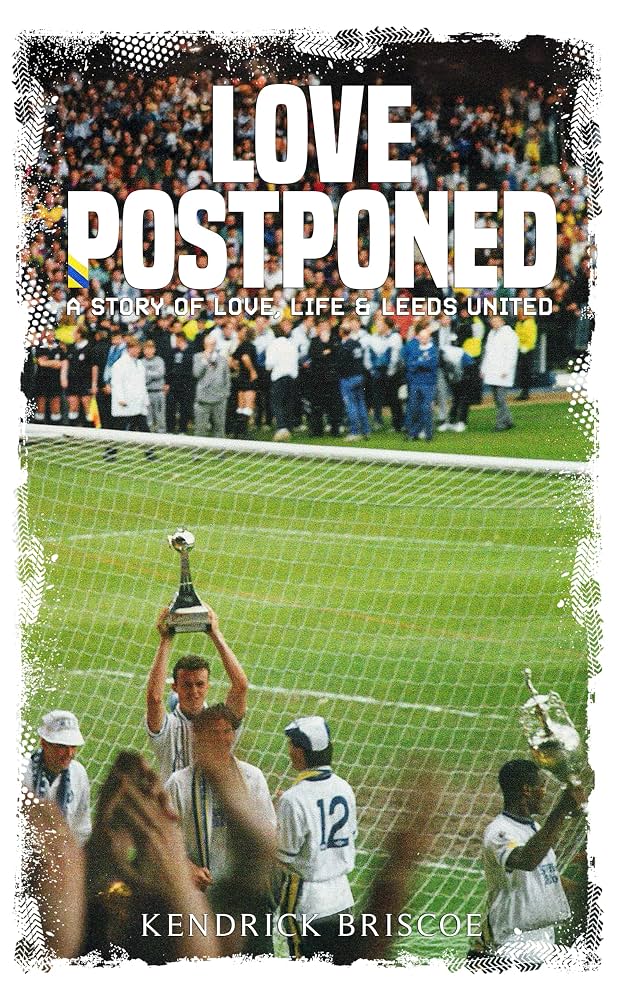
Now, there’s a thought. And as it happens, that’s exactly what lifelong Leeds United supporter and author Kendrick Briscoe has been doing.
Kendrick recently got in touch with me after coming across World After The Bell. What initially caught my attention, however, wasn’t simply the fact that he’d written a book about Leeds United’s 1991/92 title-winning season. It was that he’d taken the time to read about some of the difficulties I’d experienced over the past eighteen months, and had reached out with a few genuinely kind words. What followed was a conversation about football, writing, mental health and the occasional tendency for life to be an absolute bastard. And somewhere along the way, I discovered that Kendrick had a rather interesting story to tell.
Born Leeds, Raised Leeds
The beginning of the story is pretty simple. Born in Leeds to two Leeds-supporting parents, Kendrick’s footballing allegiance was effectively decided before he’d even learned to walk. Whether that’s a blessing or a curse probably depends on where we happen to be on the ups and downs scale at any given moment. But given that he was born just two days before Brian Clough was appointed Leeds United manager, perhaps we’ve finally identified who’s responsible for the curse.
His father maintains that his first experience of football came during the 1974 Charity Shield against Liverpool, although given that Kendrick was still a baby at the time, I suspect his memories of Billy Bremner and Kevin Keegan being sent off are somewhat limited.
Like many of us, as Kendrick grew older, he would discover that supporting Leeds United wasn’t quite as glamorous as his parents might have led him to believe. The trophies had dried up, Don Revie’s great side had long since disappeared, and Leeds were spending their Saturday afternoons in the Second Division. For a young lad growing up surrounded by Liverpool and Tottenham supporters, there wasn’t an awful lot to shout about. But then, in October 1988, Howard Wilkinson arrived at Elland Road, and within four years Leeds had gone from the Second Division to champions of England.
The Soundtrack to a Championship
There’s something about waking up on the morning of a football match that never really leaves you. That little flutter in your stomach before you’ve even climbed out of bed. The anticipation of seeing your friends, the pre-match beers in town, the journey to the ground with a pit stop at Tesco along the way, and the inevitable piss stop in Holbeck Park too.
It’s usually around then that you begin to hear the chatter of other supporters making their way towards Elland Road. The voices grow louder, the crowds get thicker, and the excitement builds as the floodlights and the East Stand eventually come into view.
Now imagine all of that at seventeen. Your whole life ahead of you, a little freedom in your pocket, and Leeds United challenging for the championship.
It’s 1991. You’re young, you’ve got a little money in your pocket, your mates are waiting, and the entire weekend is stretching out in front of you. There’s music to listen to, girls to impress, and probably a few things you haven’t told your parents about. No mobile phones, no obsessively refreshing Twitter for team news, and nobody expecting you to be contactable every minute of the day. Responsibilities are slowly creeping over the horizon but they’re still far enough away that you can comfortably pretend they don’t exist. You’re seventeen. You feel indestructible. The idea that life might one day become complicated hasn’t quite sunk in yet. For Kendrick Briscoe, these were the years of first jobs, first cars, friendships, teenage romance and away days following Leeds United. The sort of experiences that seem perfectly ordinary when you’re living through them, but which somehow become more precious with every passing year.
And the soundtrack wasn’t half bad either. The Stone Roses, Happy Mondays, The Charlatans and Inspiral Carpets. Bands whose music had become inseparable from the youth culture emerging across northern England at the turn of the decade. Baggy jeans, long fringes, nights out, and the belief that another pint was always a good idea. Manchester might have been getting most of the attention, but the music travelled considerably further than the M62.
It was an interesting time to be growing up in Britain. Margaret Thatcher had left Downing Street in November 1990, John Major was now Prime Minister, and the country was struggling through a recession. Unemployment was rising, and the industrial communities of northern England were still dealing with the consequences of the previous decade. The future was far from certain, particularly for young people preparing to enter the world of work. But I suspect that on a Saturday morning, with Leeds United playing and the lads waiting to meet you, the state of the British economy wasn’t necessarily the first thing on your mind.
And, as it happened, the football started to provide some joy. Howard Wilkinson had already dragged Leeds out of the Second Division and back into the First Division. Now, rather unexpectedly, they were challenging Manchester United for the league championship. For Kendrick’s generation, who’d grown up listening to their parents talk about Don Revie’s great side, this was something entirely new. They weren’t relying on stories about Bremner, Giles and Clarke anymore. They had their own team, their own heroes, and the possibility of witnessing something their parents had last experienced eighteen years earlier. And while the Stone Roses and Happy Mondays were providing the soundtrack, Wilkinson’s Leeds were doing their best to make the season unforgettable.
By April 1992, they’d done exactly that. A victory at Sheffield United, followed by Manchester United losing at Anfield, confirmed Leeds United as champions of England. The last champions of the old First Division before the Premier League arrived, and the first Leeds side to win the title since 1974. Not only had Kendrick witnessed Leeds win the championship at seventeen, but they’d beaten Manchester United to it.
I bet there weren’t many better times to be a teenage Leeds supporter. And perhaps that’s what makes Love Postponed such an interesting idea. Because while the rest of us remember 1991/92 for the football, Kendrick has gone back to everything else that was happening around it. The music, the friendships, the girls, the first taste of independence, and all the questionable decisions that come with being seventeen.
Leeds United winning the league was quite an achievement. But for Kendrick, there was a whole lot of life happening at the same time.
From Supporter to Author
Fast-forward thirty-odd years, and Kendrick Briscoe had long since swapped the carefree existence of a seventeen-year-old Leeds supporter for the considerably less exciting business of being an adult. Work, responsibilities, bills, and all those other wonderful things nobody bothers warning you about when you’re young.
What he probably hadn’t anticipated, though, was that he’d eventually become a novelist. And certainly not under the circumstances that led him there. Kendrick and I have rather similar stories when it comes to what led us towards writing, and I think that’s partly why we got on so well. Although, having exchanged a fair few emails with him now, I’m beginning to worry that I’ve accidentally made a new friend.
Following a health scare, Kendrick began writing short, humorous stories as a way of keeping his mind occupied. There was no grand plan to become the next bestselling author, no lifelong ambition to see his name on the front of a book. He simply found that putting pen to paper, or fingers to keyboard, gave him something positive to concentrate on. His wife, however, clearly thought there was more to it than that. Having been forced (for better or for worse) to read his stories, she encouraged him to take his writing further. And, rather than doing what most husbands do when their wives offer sensible advice, Kendrick actually listened. Which, in itself, probably deserves some recognition.
What followed was Double Slip, a time-slip romance that marked his first proper venture into novel writing. Not exactly the sort of subject you might immediately associate with a lifelong Leeds United supporter, but then I suppose there are only so many stories you can write about the misery of following a football club before somebody starts recommending counselling.
And it turned out Kendrick wasn’t half bad at this writing business. An encouraging response from his proofreader helped convince him that his work might have an audience beyond his immediate family. There must be something rather satisfying about discovering that somebody who isn’t married to you actually enjoys reading what you’ve written.
More books followed, with Kendrick exploring different ideas and genres as his confidence grew. What had begun as a way of distracting himself during a difficult period had developed into a genuine creative passion. And eventually, he found himself returning to something he’d known and loved for most of his life.
Leeds United.
Love Postponed – and What Comes Next
Drawing inspiration from Nick Hornby’s Fever Pitch and Robert Endeacott’s One Northern Soul, Kendrick began putting together a story that combined his love of Leeds United with the friendships, relationships and general stupidity that come with being a teenage lad. His own description of Love Postponed is probably the best way of explaining what he was aiming for: Fever Pitch meets The Inbetweeners, with a dash of Notting Hill. It all sounds absolutely bonkers (shoutout to Dizzee Rascal) when you put it like that, but I can kind of see what he means. Football obsession, teenage romance, questionable decisions and the inevitable embarrassment that comes with trying to impress somebody you fancy. And, somewhere in the background, Howard Wilkinson is busy winning the league.
Although Kendrick has drawn on his own experiences, Love Postponed isn’t simply an autobiography disguised as fiction. He’s taken the people, places and experiences that shaped his teenage years and used them as inspiration for a story of his own. What I do like, though, is how attached he became to the characters. He told me that when he’d finished writing the novel, he actually missed them. These were people he’d invented, given personalities to, and spent countless hours getting to know. And then, rather inconsiderately, he’d reached the end of the book and had to say goodbye to them.
As somebody who spends a frankly unreasonable amount of time thinking about fictional characters myself, I can understand how that might happen. Although I suspect there’s a slight difference between creating your own characters and spending ten+ years wondering why George R. R. Martin still hasn’t finished The Winds of Winter. Thank God for Joe Abercrombie. I’ve experienced something similar with my own writing, particularly the pieces I’ve poured the most time into. My features on Dominic Calvert-Lewin and the Haaland What If…? series immediately spring to mind. Although I reckon Kendrick has invested far more time in his characters than I have in imagining an alternative universe where Leeds signed Erling Haaland.
Fortunately, Kendrick won’t have to spend quite so long wondering what became of his own creations. Because, in a little exclusive for World After The Bell, Kendrick has revealed that he’s currently working on a sequel to Love Postponed. So, for anybody who finishes the book and finds themselves missing the characters as much as their creator did, there’s some good news.
Their story isn’t over just yet.
In Conversation With… Kendrick Briscoe
1. You’ve described the 1991/92 season as one of the happiest periods of your life. And how Love Postponed combines football, friendship, music and the various disasters that accompany teenage romance. If you could relive just one Saturday from that entire season, from waking up to stumbling home afterwards, which would you choose?
It’s probably the away day at Aston Villa, the performance was breathtaking, we just took Villa to the cleaners. It was live on TV and we put out such a statement of intent to the watching country. Villa were a decent team so it wasnt like we had beaten nobodies, we were just so good on the day. The best bit personally, was my position in the away stand which was literally right on the segregation line between the villa fans and Leeds fans – we were in the stand on side of the pitch. I recall like it was yesterday celebrating each goal stood on my seat facing the Villa fans who were all doing their best not to look at us. That result really made the country look at Leeds in a new light, we wasn’t pace setters, we were title contenders.
2. You’ve suggested that Howard Wilkinson’s achievements might actually outweigh those of Don Revie, which is certainly a brave statement to make amongst Leeds supporters! If you had to convince someone who grew up watching Revie’s side, what would be your strongest argument?
Well firstly, that statement is in no way disrespect to Don Revie one bit! My thinking is that Howard Wilkinson came to a club with HUGE expectation, it was only 14 years since we were League Champions and the place still had images and memorabilia of those great days that were practically impossible to live up to. Wilkinson’s achievements in terms of silverware and dominance fall short of Revie but what Wilko did for the club has spanned decades. Wilko was instrumental setting up our academy and the players the academy produced quite possibly helped the club stay in existence with the likes of Robinson, Smith, Milner, Lennon, Kilgallon, Walton etc all sold at various times that kept the club financially just about with its head above water. The academy still produces talent and will continue to do so because of Howard Wilkinson.
3. You’ve spoken about the Stone Roses, Happy Mondays and Charlatans providing the soundtrack to your teenage years. If you could choose one song that immediately transports you back to that period, what would it be, and what memories does it bring with it?
It has to be Waterfall by the Stone Roses. It was released in 1991 and the lyrics felt so fresh about breaking free and going on to new things. It felt like me at the time, finishing sixth form and embarking on a new world. It also was quite apt for Leeds as were breaking free from those years of living under the Revie years shadow and creating a new piece of history.
4. Football supporters have a wonderful habit of convincing themselves that everything was better in the past. But looking back at following Leeds in the early 1990s, is there anything about the experience that you genuinely don’t miss? And, conversely, what’s something about football back then that you wish we could bring back today?
Back then, football still had an edge, going to away grounds had an element of slight danger about it. It was probably danger at the time that I was oblivious too. I remember a great idea I had to beat queues for the toilets in a service station by going to the opposite carriageway of a service station and walking into hundreds of Sunderland supporters who, as you can imagine gave us a lovely greeting! There was many away days when things could have taken a nasty turn. I also recall Middlesbrough beating us 4-1 in 1992 and our minibus getting bricked – god knows what they would have done if we had beaten them! Those days are better in the past.
A thing I would bring back? Proper physical challenges for the ball where there was as much skill in a tackle as there was in an overhead kick. I hate it when a player goes down because he ‘feels’ a hand on his back. And as for VAR – don’t get me started!
5. When writing a largely autobiographical book, there’s presumably a moment when you realise that people you actually know might recognise themselves in the characters. Has anyone read Love Postponed and subsequently had a few questions for you?
Ha, well so far no, but this may inspire a few people to read and get in touch! There are quite a lot of real life events in the book and to be honest it made it really easy to write and great fun. As the cliche goes, the names have been changed to protect the innocent!
6. Speaking to you, you’ve described Love Postponed as Fever Pitch meets The Inbetweeners, with a dash of Notting Hill. That’s quite a combination! Given how much of the book draws upon your own experiences, were there any incidents you had to tone down because readers might struggle to believe they actually happened? For example, I once got so drunk at an away game that I ended up in the back room of a pub in the middle of a funeral. I had been chatting to the widow at the bar who thought I was great fun and invited me into the back where it was being held. Lol.
There was a few that was better to exclude, one of which was a mate being sick into his bag on the coach going to an away game which was not particularly unbelievable, but I had to think about if someone was reading the book and about to tuck into their breakfast! I’d say 90% of it happened which highlighted to me how much of a blast I had during that time.
7. You mentioned that you genuinely missed the characters when you finished writing Love Postponed, and you’ve kindly revealed that a sequel is already in the works. Without giving too much away, what can readers expect from the next instalment?
Well the sequel will answer what happened to the characters after 1992 and we land in 2007 when Leeds are in League One. We go from a our best season in recent history to our lowest ebb. But the story continues with the fortunes of the main characters and as before in Love Postponed, its all framed with the Leeds United fixture list.
8. Finally, imagine you could travel back to 1992 and have a conversation with your younger self. Knowing everything that has happened to Leeds United in the thirty-odd years since, from Champions League semi-finals to League One and everything in between, what would you tell him? Would you offer a few words of warning, or simply tell him to enjoy every bloody minute?
Quite simple, I’d say, this is as good as it gets for a long while so enjoy every bit of it while it lasts. I might be tempted to tell him that by the time he is in his 40s the club will be in the third tier, but why would I do that to someone? No matter what I could say would not dampen the love for Leeds United.
Author’s Note:
I just want to say what an absolute pleasure it’s been getting to know Kendrick. He’s been incredibly generous with his time, and given me plenty of support regarding my health.
I think you’ll agree that his answers are fantastic. You can feel his genuine passion and affection for Leeds United running through every one of them, and you can tell just how much those years meant to him. The memories are still as vivid as ever, and there’s certainly no mistaking him for somebody who jumped on the bandwagon when Wilkinson started winning things.
He’s one of us. And, more importantly, he’s one of the good guys.
So, Kendrick, if you’re reading this, thank you. For your time, your kindness, your honesty, and for reminding me that there are some really lovely people in the Leeds United community.
And to everybody else, please do take a moment to check out his books and website. I’ve included the links below. Supporting independent writers costs nothing if all you’re doing is sharing their work, and it can make a hell of a difference.
Love Postponed – Amazon Paperback
Enjoyed this? After The Bell will always be free. If you'd like to support the site, you can buy me a coffee and cake. It's Farke's favourite. 🤍💙💛
Leeds shirts from years gone by.
From Strongbow and Whyte & Mackay to some of the absolute monstrosities we've somehow become nostalgic for. Browse classic Leeds United shirts and retro gear at 3Retro.


