Over the past few weeks, I’ve seen plenty of people online arguing that this doesn’t feel like a World Cup month. And, to be fair, I understand where they’re coming from. The pitches have come under criticism. FIFA remain FIFA. Politics seems incapable of staying out of anything these days. Everywhere you look, there appears to be another controversy threatening to overshadow the football. Yet I can’t help but disagree. Maybe it’s because I don’t leave the house often enough. Maybe it’s because football has occupied an unhealthy amount of space in my brain for more than twenty years. Or maybe it’s because the World Cup still retains a kind of magic that no other sporting event can replicate. Whatever the reason, I am absolutely gripped by World Cup fever. So give me vuvuzelas. Give me samba drums. Give me face paint, flags, and cameramen picking out the finest women in the crowd! The World Cup is back baby!
Nostalgia
As a child growing up in Ireland, the World Cup felt different. The tournament was an event not to be missed. A chance to sit around the TV with your family to watch the world’s best. Time seemed to stand still: school stopped; work was paused; life just came to a halt.
Maybe every generation says that it was different. Maybe it’s simply what happens when adulthood arrives and begins replacing excitement with responsibilities. The mortgage matters. The school run matters. The weekly food shop matters. Yet there was a time when none of that existed and the World Cup felt like the most important event on the planet.
Every four years, football stopped belonging to clubs and temporarily belonged to nations. Panini sticker albums came out. Debates over cold pints became heated diplomatic incidents. Fights ensued over who got to be Brazil in the school yard despite not making a shred of difference to your ability. We all became overnight experts on countries we couldn’t locate on a map the previous week. Internet was scarce in those days. Computers in a house? Maybe if you were rich. But for one glorious month, the entire world seemed to revolve around football. As the great one would say: “Bueno”.
My earliest World Cup memory comes from 2002. I was on a school tour in Paris when Ireland faced Cameroon in the opening game. I can still remember teachers waking us up at the crack of dawn so that we could watch Matt Holland crash an equaliser into the net.
A few days later, we were back home and supposedly back to reality. Except it wasn’t really reality at all. Each day the TV was wheeled into the room so that thirty children could crowd around a screen that probably wasn’t much bigger than a microwave by modern standards. Lessons became secondary. Maths could wait. The World Cup could not.
When Ireland played Germany, normal life practically ceased to exist. Parents phoned schools claiming their children were sick. The same parents then phoned their own workplaces expressing exactly the same thing. By lunchtime, half the town seemed to be in the local pub watching the match, with employees sat alongside the bosses they had both lied to that morning. Nobody cared. It was the World Cup. And when Robbie Keane scored that equaliser in the 90th minute? Pande-fucking-monium.

Unfortunately, the Irish dream wasn’t to be. But by that point the damage had already been done. We were hooked. The World Cup had us. Long after the final whistle had blown on Ireland’s tournament, we were still running around fields pretending to be Zidane, Vieri and Batistuta. These weren’t just footballers to us. They were larger than life. Foreign. Exotic. Mysterious. In an age before social media gave us access to every footballer on earth twenty-four hours a day, these players felt like they belonged to another world. They captured the imagination.
And for me, like millions of others, no team captured the imagination quite like Brazil.

It wasn’t just that they were successful. Plenty of nations have won trophies. Germany won trophies. Italy won trophies. Argentina won trophies. What made Brazil different was the way they seemed to play the game. Football looked fun when Brazil played. They looked like kids who had never really left the schoolyard.
The shirts helped, of course. There has never been a more iconic kit in football than that yellow shirt. You could show its silhouette to somebody who had never watched a football match in their life and they’d probably recognise it. Yet it went far beyond the kit. There was a swagger to Brazilian football that felt completely unique. Every flick seemed unnecessary. Every dribble felt slightly disrespectful. Every goal looked as though it had been dreamt up five seconds earlier. They didn’t just beat teams. They humiliated them. They toyed with them. And somehow they made it all look effortless.
I watched the 2002 World Cup final camped in my bedroom in front of a tiny box television, squinting through a grainy RTÉ feed that would probably be considered a crime against broadcasting standards by modern audiences. It didn’t matter. I was glued to the screen. I sat there absolutely mesmerised by them. Ronaldo bulldozing defenders. Rivaldo gliding across the pitch. Ronaldinho doing things that simply didn’t appear to obey the laws of physics. Looking back now, I realise I wasn’t just watching a football team. I was watching footballing Gods.
The Original. The Greatest. R9

Like many things in life, you don’t appreciate them until they’re gone. Sitting in my bedroom watching the 2002 World Cup at twelve years old, it never occurred to me that these players wouldn’t be around forever. As a child, footballers exist in a strange state of permanence. You assume they’ll always be there. That Zidane will always glide past midfielders. That Klose will always be scoring goals at World Cups. That David Villa will always be cutting in from the left-hand side. You never stop to consider that one day you’ll be watching them for the final time. Looking back, that’s one of the cruellest tricks football plays on us. We rarely realise we’re witnessing the end of an era until the era has already ended. That we’ll not get to witness the greats again.
And for me, the pinnacle of greatness was Ronaldo.
Not Cristiano Ronaldo. Fuck no!
Ronaldo. R9.
The phenomenon.
Even now, trying to explain him to younger supporters feels almost impossible. Statistics don’t really do him justice because statistics only tell you what happened. They don’t tell you how it felt. They don’t tell you about the sense of anticipation every time he received possession. They don’t tell you about defenders visibly panicking before he’d even made his move. They certainly don’t tell you about that legendary haircut in 2002. If you picture him now, you see him wagging his finger, right? The epitome of greatness. He was outrageous. Strong enough to bully centre-backs. Quick enough to outrun full-backs. Technical enough to embarrass midfielders. Ronaldo played football like somebody had accidentally turned all his attributes up to maximum. They say big players step up in big games, and Ronaldo stepped up in the 2002 World Cup final scoring both goals.
Yet the beautiful thing about that era wasn’t Ronaldo alone. It was the cast around him. Rivaldo was there. Ronaldinho was there. Cafu was there. Roberto Carlos was there. Looking back now, that 2002 side feels less like a World Cup squad and more like something a twelve-year-old would create on Pro Evolution Soccer when he realises he can edit the stats. We all did that, right?
That was always Brazil’s gift to football. They produced footballers who felt larger than life.
The generation before had Pelé.
Then came Zico and Sócrates.
Then Romário and Bebeto.
Then Ronaldo and Ronaldinho.
Every era seemed to produce another collection of footballing icons.
Which is why the last decade has felt so strange.

The players remained excellent. Nobody could ever accuse Brazil of lacking talent. Neymar became one of the most gifted players of his generation. But the hopes of a nation have rested on his shoulders for too long. Alisson established himself among the finest goalkeepers on the planet. Casemiro dominated Europe with Real Madrid. Vinícius Júnior emerged as one of the most devastating attackers in world football.
Yet something felt missing. The aura disappeared.
That might sound ridiculous because football clubs and national teams don’t actually possess an aura. They’re not mythical creatures. They’re collections of human beings. Yet every football supporter knows exactly what I mean. When you came up against them, you feared them. Certain teams carry a feeling with them. The great Leeds United sides under Don Revie had it. Manchester United under Ferguson had it. Barcelona under Guardiola had it. And for most of football history, Brazil possessed more of it than anybody.
When teams played Brazil, they weren’t simply facing eleven footballers. They were confronting decades of history. Every yellow shirt carried memories of Pelé. Of Garrincha. Of Zico. Of Romário. Of Ronaldo. Opponents weren’t just facing the current team. They were facing every great Brazilian team that came before it.
And yet, since 2002 it’s been disappointment. Quarter final exit in 2006. Quarter final exit in 2010.
Then came Germany. Seven-one.
I remember watching that semi-final in complete disbelief. Not because Germany won. Germany were brilliant. It was the manner of it. Brazil looked shell-shocked. Broken. For ninety surreal minutes, football’s most famous nation seemed to forget how to play football.
I’d only recently moved to the UK and was sat alone in a hotel room in Purley Oaks. Good luck finding that on a map. There was nobody else there. Nobody I could turn to and ask whether they were seeing the same thing I was. Every few minutes I found myself looking back at the scoreline just to make sure it was real. Seven-one. It felt less like a football match and more like a collective hallucination.
The image that stays with me isn’t one of Germany’s goals. It’s the crowd. Grown adults crying in the stands. Children staring blankly into the distance. An entire nation watching a sporting nightmare unfold in real time.
The camera repeatedly cut to David Luiz, who fought to hold back the tears. In truth, fourteen years later I still find this funny.
In hindsight, that defeat became a dividing line. There was the Brazil before Germany. The joy. The brilliance. The immortals. And the Brazil after Germany. The disappointment. The let downs.
Don’t get me wrong, the years that have followed have brought plenty of talented squads, but none have truly convinced me. Which is easy for me to type considering I have never possessed any footballing ability. They were contenders because Brazil are always contenders, yet they never felt inevitable. The last two World Cups have seen Brazil exit in the Quarter Finals and there’s a real sense that the aura could be gone. That the swagger might be dead.
Now, if you’re still with me up until this point, you’re probably sat thinking “I thought this was a Leeds blog”. And of course I’ll be keenly watching the USMNT to see if Brenden Aaronson increases his transfer value this summer; to watch Ao Tanaka put his silky skills to use for Japan; to admire Gabi Gundmundsson making more lung bursting runs; to hope and pray Noah Okafor doesn’t snap his hamstring. I’ll be watching as Marcelo Bielsa attempts to go out with a bang with Uruguay. Not that they deserve the man! Come home Marcelo, come home.

And yet, the team I’ll be watching with a keen eye, is of course Brazil. Why did we fall in love with football? Football supporters fall in love with moments. For the thunderbastards. The flicks. The tricks. The je ne sais quoi. And this is where the current Brazil squad becomes interesting. For the first time in a very long time, Brazil feel exciting again. Not because they are perfect. They aren’t. This year they arrive at the World Cup as the world’s sixth-best side, their lowest-ever ranking prior to a World Cup since FIFA began compiling their list in 1992. Picture this, Brazil are the only South American side at this World Cup who suffered six defeats in qualifying – to put that into context, they only lost five qualifying games over the past 20 years combined.
But there is still excitement. Not because they possess the greatest collection of players in their history. They don’t. What excites me is that this squad appears to understand what Brazil should be.
There is pace everywhere.
There is flair everywhere.
There is confidence everywhere.
This is not a squad short on quality. Alisson remains one of the finest goalkeepers in world football and arrives as both a Premier League and Champions League winner. Ahead of him sits a defence packed with experience and success. Gabriel has just helped Arsenal lift the Premier League title, while Marquinhos arrives fresh from captaining Paris Saint-Germain to Champions League glory.
The midfield is equally impressive. Casemiro may no longer be at his peak, but the five-time Champions League winner has enjoyed a strong campaign with Manchester United. Alongside him, Bruno Guimarães has established himself as one of the Premier League’s most complete midfielders and has been instrumental in Newcastle’s remarkable turnaround from the Mike Ashley era.
Further forward, the talent becomes almost absurd. Endrick arrives carrying the sort of expectation that only Brazil can place upon a teenager. Matheus Cunha has developed into a wonderfully creative forward capable of producing moments of genuine quality. Igor Thiago enjoyed an outstanding campaign, finishing second in the Premier League scoring charts.
Then there is Vinícius Júnior. Somehow, despite being one of the most electrifying footballers on the planet, he continues to face criticism for his performances in a Brazil shirt. The accusation has never entirely made sense to me. In Qatar, he was directly involved in five of Brazil’s seven goals, yet still emerged from the tournament with questions surrounding his contribution. Such is the burden of representing Brazil; excellence is expected, and even that sometimes isn’t enough.
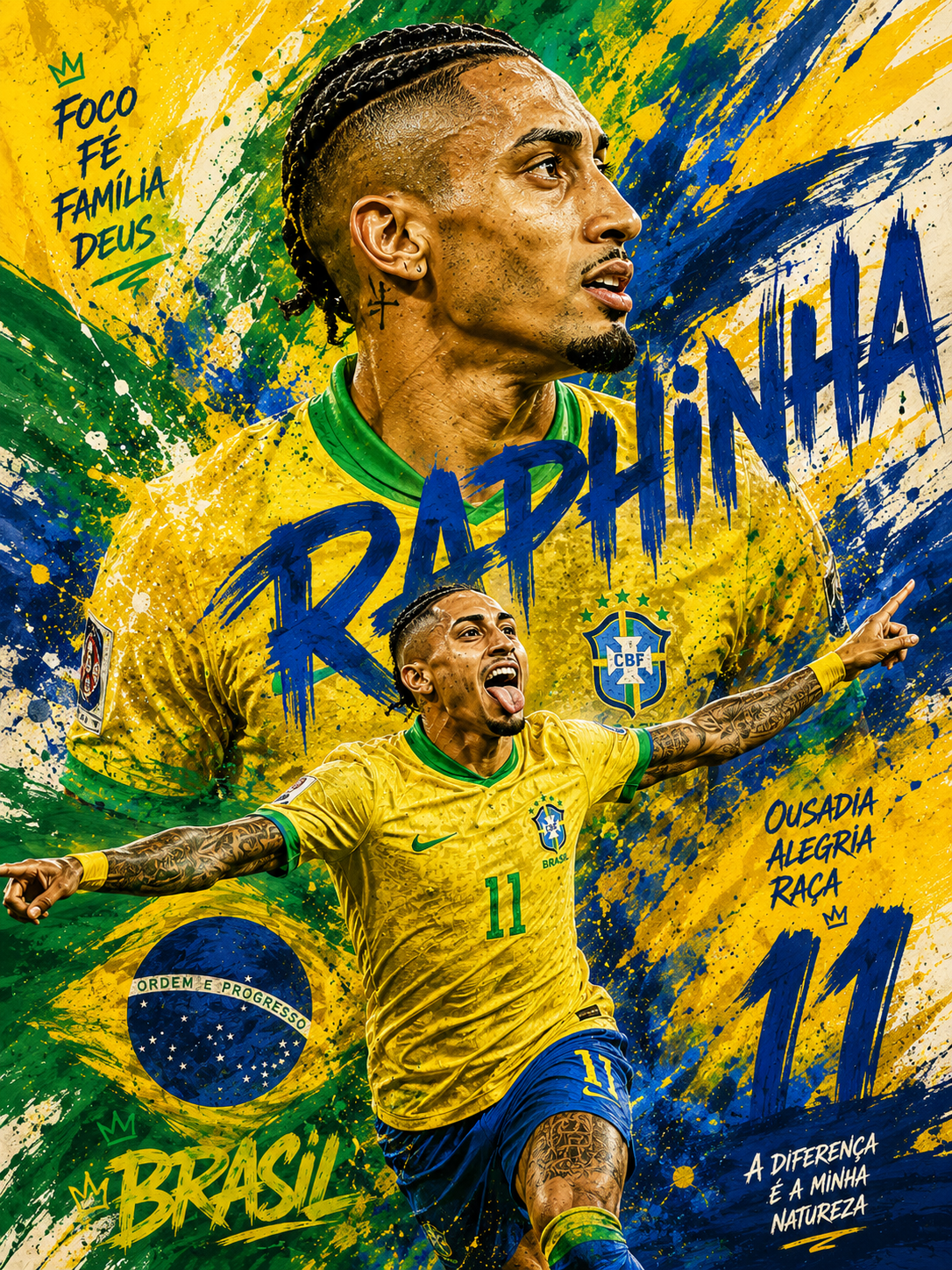
Then there is Raphinha.

And this is probably where any semblance of neutrality disappears entirely. Leeds supporters knew Raphinha was special long before the rest of the football world caught on. The way he used to glide down the right, cut in on his left and smash it into the net. Ending Gary Cahill’s career with a disgustingly sexy nutmeg? Chef’s kiss. And walking the length of the G-Tech Community Stadium in London, as a thank you to God that Leeds stayed up in the 2021/22 season. A player who had the world at his feet, but Leeds United at heart.
Some players entertain supporters. Some become woven into a club’s story. Raphinha belongs firmly in the second category. The man was even trying to help Leeds recruit players last summer, speaking to Igor Paixão on the club’s behalf while starring for Barcelona. That’s not normal behaviour from someone who spent only two seasons at Elland Road. It tells you everything you need to know about how he feels about Leeds United.
When Leeds returned to the Premier League under Marcelo Bielsa, there was a sense of possibility around the club that had been absent for years. In that first season, we weren’t merely making up the numbers. We were competing. We were exciting. We mattered again. And in many ways, Raphinha embodied all of that. Every time he received the ball, something felt possible. Defenders backed away. Entire matches felt like they could change in an instant.
Go back and watch Leeds against Norwich with the camera focused solely on the bench. You can tell the exact moment Raphinha gets the ball. Players rise from their seats. Coaches edge forward. Everybody expects something to happen. He was the player who made you believe anything was possible.
Leeds needed him desperately during some incredibly difficult periods. There were moments when he felt like the only thing standing between survival and disaster. Yet even under that pressure, he never lost the sense of joy that defines the very best Brazilian footballers.
That is why I find myself smiling when I watch him now. Not because I regret losing him. Barcelona was always inevitable. Players of that quality don’t remain at Leeds United forever in our current cycle. Instead, I smile because there is something satisfying about watching the rest of the world discover what we already knew.
The wider football public now sees an elite winger. Leeds supporters remember the beginning of the story. The fish and chips. And perhaps that is why this Brazilian team appeals to me so much. Because for the first time in years, they remind me of the Brazil I grew up watching. Not the exact same players. Not the exact same style. Not the exact same era. Perhaps it’s solely because of Raphinha that I feel excited to see Brazil. But isn’t that the point? Football is about emotions. Football is about excitement. Twelve-year-old me sat in awe at the sight of Ronaldo. It’s only right that thirty-six-year-old me do the same with Raphinha because of those same feelings. Football is supposed to be fun. Brazil understood that better than anybody for generations. Somewhere over the past decade, they seemed to forget. Watching this squad, I think they might finally be remembering. And if not, well perhaps the manager can remind them who they are.
“Carlotta”

Perhaps the biggest difference this time, however, isn’t a player at all, but the man standing on the touchline.
For years, Brazil have searched for the coach capable of restoring the nation’s faith in itself. Some arrived with tactical blueprints. Others arrived with grand ideas. Most eventually discovered that managing Brazil is unlike managing anybody else. Winning isn’t enough. You are expected to win beautifully. Every defeat becomes a national conversation. Every draw becomes a crisis.
Then came Carlo Ancelotti.
On paper, the appointment felt slightly bizarre. An Italian managing Brazil? It sounded wrong. Like ordering a Guinness in Milan or putting pineapple on a Sunday roast. Yet the more I think about it, the more sense it makes.
Ancelotti doesn’t need Brazil. He has nothing left to prove. He has won league titles in five different countries. He has lifted the Champions League so many times that it almost feels rude to keep counting. He has managed some of the biggest personalities the game has ever seen and somehow convinced all of them to pull in the same direction.
More importantly, he understands stars. This Brazil squad is full of them.
Vinícius Júnior has already flourished under him at Real Madrid. The younger players will listen because of his reputation. The older players will listen because of his achievements. For the first time in a very long time, Brazil don’t simply look talented. They look calm. And that might be Ancelotti’s greatest gift of all.
And let’s be perfectly honest with ourselves, Ancelotti is fucking cool. Brazil faced Egypt in a friendly on Saturday night in Cleveland, Ohio. Ancelotti arrived on the touchline in an immaculate three piece suit, and a pair of sunglasses.
Don Carlo indeed.
The Verdict

Maybe Spain will win it.
Maybe France will overpower everyone.
Maybe Argentina will find another way to defy logic and reality.
That is the beauty of tournament football. Nobody knows. But if you’re asking me today, three days before the World Cup begins, which nation I think will be lifting the trophy in a month’s time, I’m going with Brazil.
Perhaps it’s nostalgia. Perhaps it’s sentiment. Perhaps it’s simply the football romantic in me refusing to grow up. Or perhaps football’s greatest dream is finally waking up again.
O Jogo Bonito
Enjoyed this? After The Bell will always be free. If you'd like to support the site, you can buy me a coffee and cake. It's Farke's favourite. 🤍💙💛
Leeds shirts from years gone by.
From Strongbow and Whyte & Mackay to some of the absolute monstrosities we've somehow become nostalgic for. Browse classic Leeds United shirts and retro gear at 3Retro.


