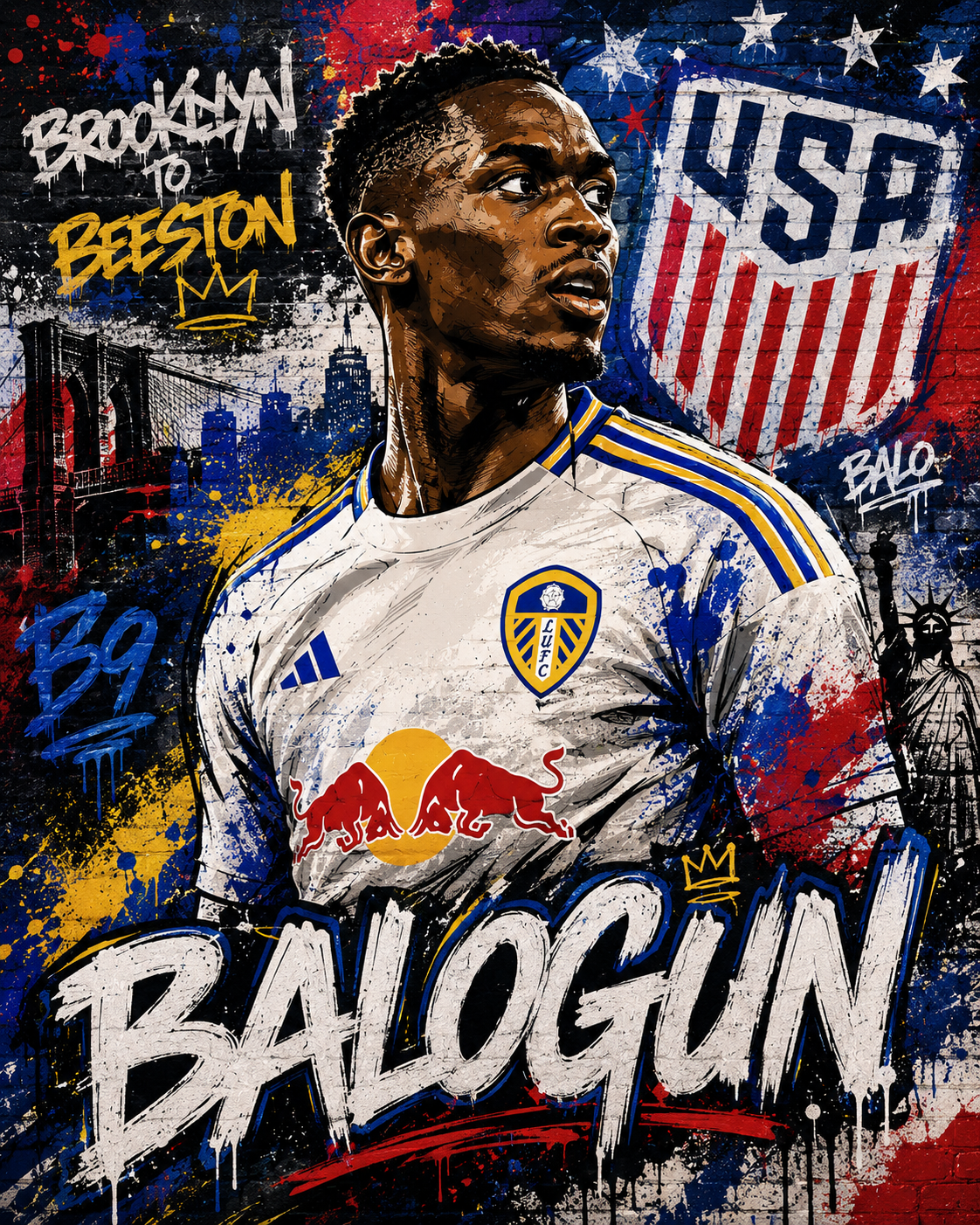
The transfer market is well and truly underway. Manchester City have overpaid for Elliott Anderson, Spurs appear to have rediscovered the key to Levy’s old warchest, and Newcastle suddenly have a problem where half of their decent players seem to want out. Ouch. Leeds, meanwhile, are going about their business in a way that has become a hallmark of the club since the 49ers took over: quietly, smartly, and with very little noise.
Harry Wilson’s arrival on a free transfer felt like a sign of where Leeds are trying to go. It is ambitious. It is sensible. It is exciting. “Free” is doing a fair bit of heavy lifting there given the wages and signing-on package that will be involved, but the broader point still stands. It is the kind of deal that should, in theory, allow Leeds to direct serious money elsewhere for one of the bigger signings this squad still needs.
Leeds’ pursuit of Jørgen Strand Larsen in January suggested there is a real appetite to spend heavily on a striker. And in fairness, despite some of the criticism aimed at last summer’s attacking recruitment, both Dominic Calvert-Lewin and Lukas Nmecha turned out to be excellent pieces of business. Between them, they gave Leeds enough to stay afloat and gave the club a platform to start thinking about something more than survival.
But there are still huge question marks over Joël Piroe. He has always felt like the odd man out in this squad. When Leeds signed him in the summer of 2023, the thinking was obvious enough: bring in a proven Championship goalscorer to help fire the club back out of the EFL and into the Premier League. His first season never really caught fire, but the second ended with him as the division’s top scorer. Even then, though, there were still plenty of Leeds supporters unconvinced by him, and I completely understand why.

There were long stretches of the season where he simply disappeared. Of his 19 league goals, four came in one glorious afternoon against Stoke, and there were too many matches in between where he drifted through the game without ever really imposing himself on it. At times, his all-round game looked clunky. The touch was loose, the movement looked laboured, and too often he struggled to affect matches unless the ball was dropping for him in the box. At Premier League level, his minutes were rightly limited and he quickly fell to third in the striker pecking order.
Now, with Piroe entering the final year of his contract, this feels like the natural point for Leeds to cash in. There will be Championship clubs interested. There may well be interest from abroad too. And if Leeds are serious about reshaping the attack, moving on from a player who no longer looks like a natural fit for what they need would make a lot of sense.
If Leeds intend to recruit another striker, it has to align with what the club has suggested publicly: they want someone capable of raising the ceiling and pushing the players already here, not somebody arriving content to be an automatic third choice. That probably means setting aside a significant portion of the transfer budget for a forward who can make an immediate impact, rather than another squad player who simply adds depth.
STRIKER: Folarin Balogun

Folarin Balogun’s profile has grown considerably since the World Cup. His performances deserved plenty of the attention, but they were quickly overshadowed by one of the tournament’s biggest talking points. After being sent off against Bosnia, Balogun was handed a suspension that was later overturned ahead of the United States’ knockout tie with Belgium. The timing of the decision, coming after public intervention from US President Donald Trump, sparked fierce debate across the footballing world, with many questioning FIFA’s independence and accusing the governing body of bowing to political pressure.
Balogun himself was little more than a bystander. He did not ask for the suspension to be overturned, nor was he responsible for the controversy that followed. But the incident thrust his name into headlines well beyond his football, turning him into one of the most talked-about players of the tournament. So naturally, I’m now going to talk about him.
PLAYER PROFILE
Folarin Balogun is a 25-year-old right-footed striker for Monaco and the United States. He was born in New York after his parents visited for a holiday whilst his mother was seven months pregnant. Airline staff wouldn’t allow her to board the return flight because of her advanced pregnancy, and the USMNT benefited as a result. Raised in England, developed at Arsenal, Balogun now sits in that slightly awkward but interesting bracket of striker: too good to dismiss, not quite proven enough to treat as a guaranteed Premier League hit. FotMob lists him as:
Monaco – 2025/26 Ligue 1
- 13 goals (4th overall)
- 4 assists (53rd overall)
- 7.03 FotMob rating (78th overall)
- .52 goals per 90 (15th overall)
- .54 xG per 90 (11th overall)
That is the starting point when we look at Balogun. But I think it’s also important not to overlook his stats at Reims or the World Cup where he also had two strong showings.

Reims – 2022/23 Ligue 1
- 21 goals (5th overall)
- 2 assists (100th overall)
- 7.09 FotMob rating (93rd overall)
- .63 goals per 90 (10th overall)
- .79 xG per 90 (2nd overall)
USMNT – 2026 World Cup
- 3 goals
- 7.01 FotMob rating
- .86 goals per 90
- .48 xG per 90
Note: I have removed the overalls because tournament football means these are all types of skewed. If a player had one good cameo off the bench, but their team was eliminated they tend to score quite highly. In this sense, it overalls don’t favour players who have played more minutes. What I think is interesting though is how similar he profiles across three different teams. For Reims, the USMNT, and Monaco, he tracks at similar levels throughout. This should give us an indication that he’s not just a flash in the pan. He’s no longer a “former Arsenal wonderkid” type.
We’re dealing with the actual player now. So what is he? He’s quick. He moves well. He can finish first time. He wants to run beyond centre-backs rather than constantly receive with his back to goal. He has enough technical quality to combine, but he is not a complete all-round number nine.
CAREER CONTEXT
Balogun came through the Arsenal academy where he was highly rated, but, like a lot of Arsenal’s academy players, never properly broke through. That does not make him a failure. Arsenal were moving into a different phase under Mikel Arteta, the standard was rising, and young strikers rarely get the patience they need at clubs trying to win titles.
A loan to Reims was what changed the opinion on the player. Here he scored 21 Ligue 1 goals and briefly sat above Mbappé, Messi, Neymar and Lacazette in the scoring charts. TNT Sports framed it at the time as the making of a potential star, with Balogun top of Ligue 1 after 21 matches despite playing for a mid-table Reims side. And it was this season which earned him the Monaco move.

Monaco paid serious money for him with The Guardian reporting the fee as €40m including add-ons, calling it Monaco’s biggest post-pandemic signing and one of the most expensive deals in the club’s history. The expectation was clear: he was not being bought as a project to hide on the bench. He was being bought to become a proper Ligue 1 and Champions League striker.
His first Monaco season, however, didn’t exactly go to plan. It wasn’t a disaster, but it certainly wasn’t the season of a €40m striker. And then his second season was disrupted badly by shoulder problems and surgery.
MATCH EVIDENCE
The World Cup definitely piqued my interest in Balogun. He looked sharp, fast, and strong for the USMNT, spearheading their attack. In the opening game against Paraguay, Balogun scored twice in the United States’ 4-1 win, with Monaco’s own report describing it as a “dream debut” and noting that he had continued his strong Monaco form from the previous six months. And whilst two goals sounds great on paper, it was the manner of the goals that impressed me most. For his first, you can see Balogun’s intelligence slowing his run so he’s available in space for Pulisic’s cut-back. That kind of movement is what creates chances for strikers in crowded boxes. Once the ball arrives, the finish is excellent too: calm, controlled, and guided beautifully into the corner with his right foot.
International football can sometimes expose strikers because they get fewer chances. The spaces are different and there is a lot of pressure – especially the emotional pressure of playing for the USMNT on home soil. Balogun looked direct and confident in front of goal. At no point did he look overwhelmed. He looked direct, confident, and dangerous whenever the ball went into him. In researching him, I have seen the argument that he is not a particularly good hold-up striker. On the evidence of this tournament, I do not really buy that. What stood out was not just the speed of his running or the threat he carried in the channels, but how willing he was to fight physically with defenders. He caused them obvious problems with his quickness and his movement out wide, but he also looked more than happy to scrap with centre-backs and came out on top often enough. His second goal against Paraguay was the best example of that. He shrugs off the defender, holds his ground, and still has the composure to whip the finish into the top corner with his left foot. It is a really impressive striker’s goal because it combines power, balance and technique all in one action.
It’s just a shame he didn’t manage a third with his head for the perfect hat-trick. Balogun finished the tournament with three goals (and also had another ruled out for offside) before the USA were knocked out by Belgium. By the end of it, he felt like one of the faces of the tournament for the Americans. AP described him as the US leader with three goals, while also covering the mental sequence that saw him sent off against Bosnia and then have that suspension lifted in time for the Belgium game. It was chaotic, but it did not really change the broader takeaway. The World Cup did not suddenly make Balogun a flawless striker. What it did do was reinforce the appeal. There’s obvious pace, quality finishing, and sharp movement. And physically, he looked far more capable of handling elite-level football than some of the criticism around him would suggest.
PHYSICAL PROFILE
Balogun’s game is built far more around movement, sharpness, acceleration and timing than raw size and aerial duels. If you’re wanting a player similar in profile to Calvert-Lewin, this isn’t it. But if the idea is to find an alternative to Calvert-Lewin, who will allow us to vary our style of play mid-game, I think he could be an excellent option.

Balogun isn’t physically dominant in the air, in the way Calvert-Lewin is. But that does not mean he is weak. In fact, Balogun is quite a powerful player who is more than capable in engaging in physical duels with defenders, and holding his own when the game becomes scrappy. The Guardian noted that, after returning for the US under Mauricio Pochettino, he showed “physicality and quality on the ball”, with his movement opening up the attack.
I often look at Football Manager when researching a player’s profile. The people at Sports Interactive have been doing this much longer than I have. And to give them their credit, they’re far better at it than I am. They rate Balogun as 16/20 for acceleration and 15/20 for pace which matches the eye test. He is quick over the ground, sharp over the first few yards, and clearly offers a different type of threat to Calvert-Lewin. If Leeds want variety up front rather than repetition, that is part of the appeal.
ATHLETICISM
As discussed above, Balogun is very quick over short distances and sharp in his movement. He is not a striker who waits between the posts for service but wants to run and drift out wide, or attack space before defenders can get set. That part of his game is one of his clearest strengths, and it is also why he has often looked more dangerous when the game opens up.
The Guardian noted that Balogun himself linked some of that movement to his background playing wide earlier in his development, which fits what you see on the pitch. He is comfortable pulling away from central areas, receiving on the move and attacking the space between full-back and centre-back rather than simply wrestling with a defender on the edge of the box.
For Leeds, that would bring a different player to the forward line. He can stretch games, threaten in behind and give midfielders an early pass into the channels. The concern is that he is less convincing when the game becomes more static. If the striker is being asked to play with his back to goal, absorb contact and act as the main focal point against deep, physical defences, Balogun is not at his strongest. He can compete, but that is not the best part of his game.

GOAL THREAT
Balogun is a genuine goal threat. The Reims season proved he’s more than capable of scoring across a full season. It was this season which earned him his move to Monaco (although the numbers involved are staggeringly high). The Monaco numbers are a bit more disappointing, but they show he can still score at a respectable level after an uneven first year and injury disruption. And yet, his 13 Ligue 1 goals last season were enough for him to finish as 4th top scorer. But it was at the World Cup which showed he can finish under pressure for the United States.
When he is confident, he looks like a proper modern striker: quick release, sharp movement, clean finishing. When he is not, he can look rushed. He can snatch at chances. He can drift through matches. And because he is not a dominant aerial striker, if he is not threatening the line, his overall influence can drop.
The above goal was disallowed for a marginal offside but it shows us a few things about Balogun. It demonstrates his ability to identify the space between defenders, utilising his movement and intelligence. Once he picks up the ball he’s then able to twist, shift it on to his “weaker” left foot, and finish beautifully. It’s a shame it was ruled out for offside because it was genuinely a lovely goal that won’t be shown in future highlights videos. But it shows me a striker who might just be starting to hit his stride.

TRANSFER CONTEXT
Let’s be honest here – Balogun will not come cheap. Football Italia, citing The Athletic, reported that Balogun would like a transfer after the World Cup and that Monaco are seeking around €50m. talkSPORT also reported Premier League interest from Brighton, Leeds United, Coventry City and Hull City, with Monaco open to a sale at around €50m / £43m. Now, I’m well aware that Italian media is less than reliable, and that talkSPORT article feels like it’s throwing a number of clubs together for clicks. But I would still expect the numbers to be about right. And if true, it’s a huge number for Leeds.
The chase for Strand Larsen shows it’s not impossible for Leeds to pay this type of figure for a player they believe in, but it is the kind of fee that means the rest of the window needs to be thought out carefully.
There is also the Arsenal sell-on clause. Daily Cannon reported that Arsenal have a 17.5% sell-on clause, while Yahoo/Sports reports also referenced Arsenal being due a sizeable percentage of any future transfer. That probably makes Monaco even less likely to accept a bargain fee.
So the question is not simply: “Is Balogun good?” The question is: “Is Balogun £40m-plus good for Leeds?”
STRENGTHS
- Movement
- Pace
- Finishing
- BSB (Big Strong Boy)
- Pressing Energy
- Hold-up play
WEAKNESSES
- Aerial presence
- Consistency
- Injury record
- Fee-to-output ratio
CURRENT LEVEL
Balogun is a good Ligue 1 striker and a good international forward. There is enough there to believe he could start for a lower-half Premier League side, but not enough yet to talk about him as a guaranteed game-changing number nine in England.
CEILING
A very good Premier League striker. Not world-class. Not one of the best in the division. But a forward who can score goals at this level, stretch defences and become a genuine asset in a strong attacking side.
FLOOR
A talented but frustrating striker who never quite justifies the fee. You can easily see a version of this where the movement is good, the goals come in bursts, but the all-round game is not quite there and Leeds end up paying top money for a player who is good rather than transformative.

OVERALL LEEDS VERDICT
There is plenty to like about Balogun. He has pace. He has movement. He’s strong. He’s scored in Ligue 1, the Champions League and the World Cup. He’s at a good age. He has Arsenal development behind him, he’s homegrown, proper European experience now, and he would give Leeds a different type of threat up front.
But I’m under no illusions about how much he’s likely to cost either. We’re looking at £40m just to get us to the table. And after the World Cup he’s just had, the player is likely to ask for a significant wage and signing on fee. At that type of package, you’re not buying potential. You’re buying certainty. And Balogun is not certainty yet. He is a talented, dangerous, still slightly uneven striker whose best football may well be ahead of him.
That’s obviously exciting. But it’s also risky. For Leeds, I’d love the player. But not if signing him means we can’t strengthen elsewhere.
Enjoyed this? After The Bell will always be free. If you'd like to support the site, you can buy me a coffee and cake. It's Farke's favourite. 🤍💙💛
Leeds shirts from years gone by.
From Strongbow and Whyte & Mackay to some of the absolute monstrosities we've somehow become nostalgic for. Browse classic Leeds United shirts and retro gear at 3Retro.


